
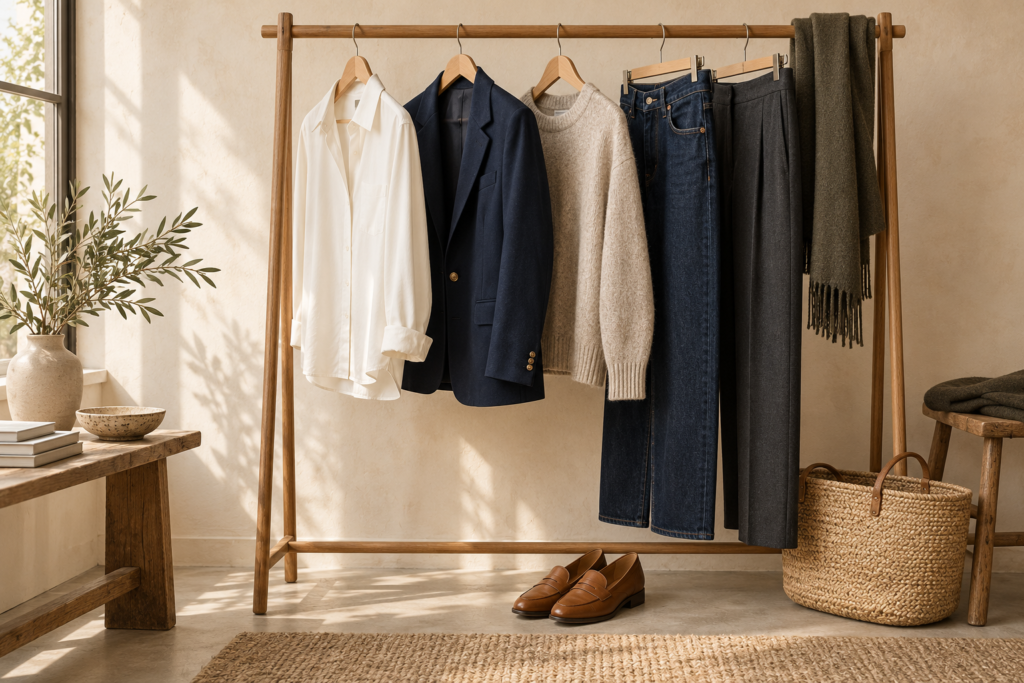
A capsule wardrobe is a small collection of clothes that work well together. It is not a rule about owning exactly 20 pieces, dressing only in beige, or replacing everything you already have. The useful goal is simpler: make getting dressed easier with clothes that suit your actual week.
Start with your own wardrobe before making a shopping list. Here is a practical way to build a flexible everyday edit, one outfit at a time.
1. Plan for your real week
Write down where you spend your time: work, home, errands, walking, evenings out. A wardrobe built around office tailoring will not help much if most of your days are casual. Think about your climate, laundry routine and how often you repeat outfits, too.
Choose the situation that causes the most frustration and solve that first. You can build a small work capsule without reorganizing your entire wardrobe.
2. Find the pieces you already reach for
Pull out five outfits you enjoy wearing. Notice what they share: a relaxed fit, a particular neckline, dark trousers, soft layers or shoes you can walk in. These are better starting points than a generic essentials list.
Set aside pieces that need a repair or a simple alteration. Keep uncertain items in a separate section for a few weeks rather than discarding them immediately. If you repeatedly reach for one, it probably belongs in your everyday edit.
3. Choose colours that connect your outfits
Pick two or three base colours from your favourite clothes, then add an accent you enjoy. Navy, cream and denim with burgundy is one option; black, grey and white with green is another. These are examples, not requirements. Prints and brighter colours belong in a capsule if you like wearing them.
Before adding a new piece, lay it beside clothes you own. Can you make three outfits with it without buying anything else? If the answer is no, consider whether it fills a specific need or creates another shopping list.
4. Build a small starting edit
For a casual week with a few smarter occasions, try this 12-piece framework using items you already own. Underwear, exercise clothes, occasionwear and weather-specific outerwear sit outside this example.
- Four tops: two everyday basics, one shirt and one top you enjoy dressing up.
- Three bottoms: jeans, tailored or relaxed trousers, and a skirt or another pair of trousers.
- Three layers: knitwear, a cardigan or overshirt, and a jacket.
- Two pairs of shoes: one for everyday walking and one that suits your smarter outfits.
Change the balance to match your life. Dresses can replace top-and-bottom combinations. A colder climate may call for more layers, while less frequent laundry may mean more tops. The number is a planning aid, not a target.
5. Test three outfit formulas
- Everyday: a simple top, jeans, an open shirt and your walking shoes.
- A little smarter: a shirt, trousers, a jacket and your second pair of shoes.
- Relaxed evening: your dressier top, jeans or a skirt, and a soft layer.
Try each outfit on, sit down, reach forward and walk around. A combination that looks good on a hanger still needs to feel comfortable in use. Take a quick photo of the outfits you like so you can repeat them on busy mornings.
6. Shop for the gap, not the whole wardrobe
After wearing the edit for two weeks, write down what was genuinely missing. Perhaps it is one washable layer or trousers that work with both pairs of shoes. Give that item a budget before browsing. Check measurements, fabric composition, care instructions and the return policy before buying online.
A low price is not a saving if the fit is wrong or the care routine is impractical. Equally, a higher price does not guarantee better construction. Look at seams, fastenings and how the garment feels, and consider second-hand options where they suit your needs.
Your first step
Choose five pieces you already like and build three outfits for the coming week. Keep what works, note the gaps, and let your capsule grow from experience. A useful wardrobe earns its place by being worn.
To finish your everyday outfits, read our practical guide to choosing an everyday bag, with advice on size, comfort, materials and useful compartments.