
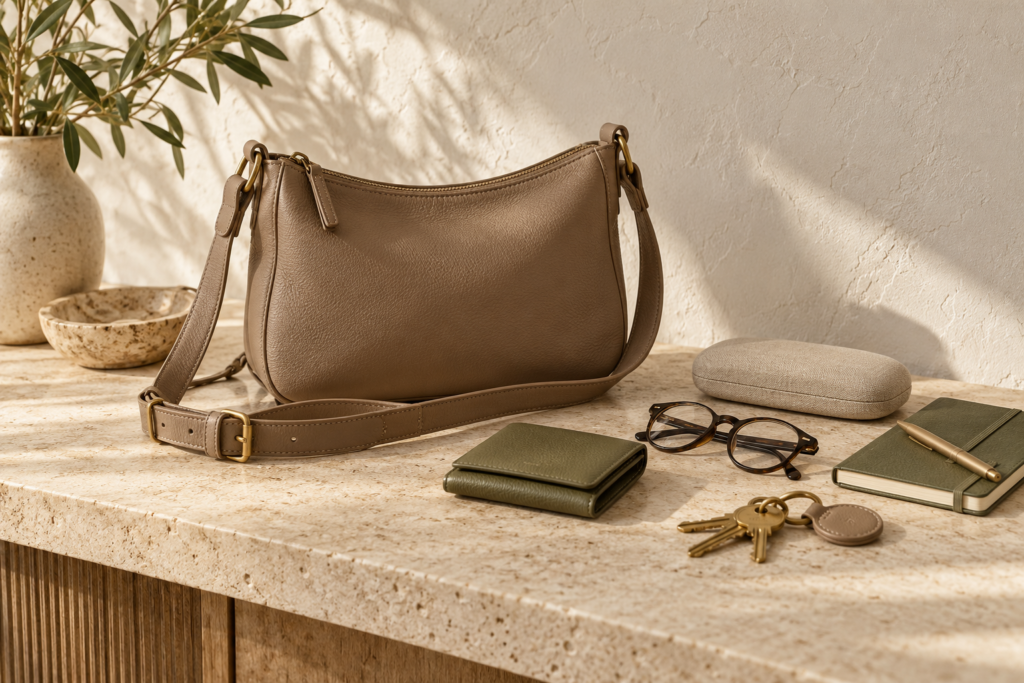
An everyday bag should make your day easier: enough room for what you carry, a comfortable strap and a shape that works with your clothes. A beautiful bag that will not fit your essentials is likely to spend more time on a shelf than on your shoulder.
Before comparing colours or labels, use this practical checklist to decide what you actually need.
1. Start with what goes inside
Lay out the items you carry on a normal day: phone, keys, wallet, glasses, a small pouch and perhaps a water bottle or book. If you commute with a laptop, include its protective sleeve and charger. Measure the largest item rather than relying on a description such as “medium” or “work bag.”
Check the opening as well as the overall dimensions. A bag can be wide enough on the outside but have a narrow zip opening or a compartment that will not fit your device. Leave enough room to find things without unpacking everything.
2. Match the shape to your routine
- Crossbody: useful when you want your hands free and carry a smaller set of essentials. Check where the bag sits when the strap is adjusted.
- Tote: useful for larger or irregular items. Look for a closure and pockets if you dislike an open, unstructured space.
- Shoulder bag: an option for a compact daily load. Test whether the strap stays in place over the coats you usually wear.
- Backpack: worth considering for a larger commuting load. Check the strap adjustment, access to pockets and space for your device.
These are starting points rather than fixed rules. A compact tote may suit you better than a crossbody, while one versatile backpack may cover work and weekends.
3. Test comfort with a realistic load
The empty weight matters, especially when a bag has heavy hardware. If you can try it in person, ask whether you can place your usual items inside and wear it for a few minutes. Check for straps that dig in, handles that feel awkward and buckles that sit against your body.
For online purchases, check the listed weight, strap length range and handle drop. Compare them with a bag you already find comfortable. Look at the return conditions before ordering, and keep any home trial within those conditions.
4. Read the material and care details
Leather, coated fabrics, canvas and synthetic materials can all suit different routines. Do not assume a material name alone tells you how long a finished bag will last. Construction, finish, use and care all matter.
Look for clear information about the outer material and lining. If a listing uses a broad phrase such as “vegan leather,” check what the material actually is and how it should be cleaned. Water-resistant and waterproof are different claims; follow the manufacturer’s stated limits rather than assuming a bag will protect electronics in heavy rain.
5. Check the details you will use every day
- Closure: can you open and close it easily, and does it suit crowded journeys or daily errands?
- Pockets: is there a convenient place for keys and a phone without too many tiny compartments?
- Construction: inspect stitching, strap attachments, lining and the movement of zips.
- Base and shape: does it stand or collapse in a way that suits how you use it?
- Care and support: are cleaning instructions and information about repairs or replacement straps available?
6. Choose a colour from your wardrobe
Take a photo of three outfits you wear often and compare the bag with them. Black, brown, navy and taupe are easy starting points for many wardrobes, but a colour you repeatedly wear can be just as useful. Hardware does not need to match every piece of jewellery. Choose a combination you enjoy rather than treating matching as a rule.
7. Set a budget before browsing
Include delivery and any likely return costs when comparing options. A discounted bag is only good value if the size, comfort and practical details work for you. A pre-owned bag can also be an option: review condition photos, measurements, seller terms and any authenticity claims carefully.
For a simple cost-per-use estimate, divide the total price by the number of uses you realistically expect. A €90 bag used 150 times works out at €0.60 per use. This is a planning example, not a reason to stretch your budget or a prediction of durability.
Three bags to compare at different budgets
These examples show how price, shape and capacity can serve different routines. They are an editorial shortlist based on brand specifications, not hands-on reviews or a ranking of durability. The links below are ordinary product links, not affiliate links.
UK listed prices checked on 26 October 2026, before delivery or optional extras. Prices, colours and availability may change. Readers outside the UK should check their local store, shipping costs and return arrangements.
| Example | Listed price | Consider it for | Main trade-off |
|---|---|---|---|
| M&S Soft Casual Crossbody Bag | £18 | Casual errands and an adjustable crossbody carry | Soft shape; the checked black version was listed as out of stock online |
| Longchamp Le Pliage Original L Tote, Black | £125 | A larger daily load and a zipped shoulder tote | Unlined interior; laptop fit does not mean padded protection |
| Cambridge Satchel The Mini, Bay | £185 | A compact leather bag for a small set of essentials | Limited interior depth; unsuitable for a laptop or bulky daily load |
Lower-cost example: M&S Soft Casual Crossbody Bag
The polyester bag has an adjustable strap, a zip closure and an internal zipped pocket. M&S lists dimensions of 27 cm high, 38 cm wide and 16 cm deep. Its casual fabric and soft shape make it worth comparing if you want an everyday bag without a large initial spend. Check the opening and loaded shape in person where possible; external measurements do not guarantee that a particular item will fit.
Availability: The checked black listing showed out of stock online. Treat this as a budget reference, and check other colours or store stock before planning a purchase. See M&S specifications and availability.
Roomier option: Longchamp Le Pliage Original L Tote
The black model L1899089001 combines recycled polyamide canvas with cowhide trim, a zip and snap closure, and two flat internal pockets. Its listed dimensions are 31 cm across the base, 30 cm high and 19 cm deep. Longchamp says it accommodates a 13-inch laptop. We would consider it for workdays or outings with more to carry, provided shoulder carry suits you.
Check before buying: The interior is unlined. Use a protective laptop sleeve and measure your device inside that sleeve; a screen-size claim alone does not establish fit or protection. A separate small pouch may help organise loose items. See Longchamp specifications and current price.
Compact leather option: Cambridge Satchel The Mini
The Bay leather version has a top handle, a detachable adjustable shoulder strap, magnetic closures and a front pocket. The manufacturer lists the main interior at approximately 18.5 cm wide, 13 cm high and 2.5 cm deep. It is a candidate for a phone, slim cardholder and a few small essentials, but measure your own items together before ordering.
Check before buying: This is a small-bag choice rather than a substitute for a work tote. The higher price buys a different material and style, not extra carrying capacity. Follow the leather-care instructions and check return conditions before adding personalisation. See Cambridge Satchel dimensions, care and current price.
Choose useful accessories before decorative extras
Pack the bag with accessories you already own before buying more. A slim cardholder can save space in a small crossbody; a zipped pouch can keep keys and small items together in a tote; a protective sleeve matters if you carry a laptop. Add only what solves an actual problem, and remember that organisers also add weight and take up space.
For outfit planning, pair this checklist with our guide to building a capsule wardrobe you will actually wear. A bag that works with your most-used clothes is often more useful than one bought for a single imagined outfit.
The final five-minute check
Before buying, answer four questions: will everything fit, will it be comfortable, will it work with my everyday clothes, and am I comfortable with the total cost and return terms? If one answer is uncertain, pause. The right everyday bag should fit your routine as well as your style.